
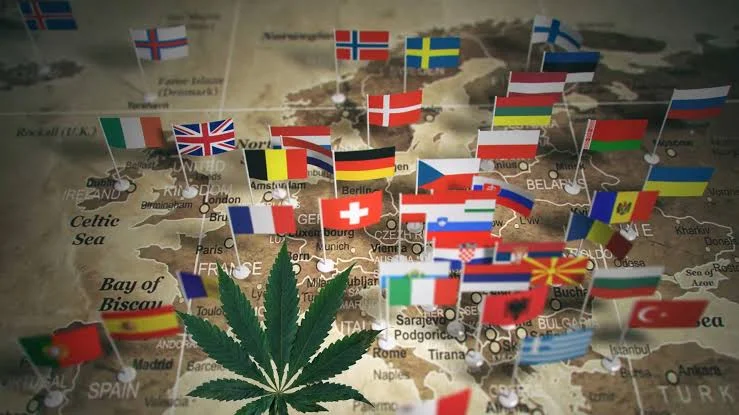
Understanding cannabis laws in Europe (2026) requires more than asking whether weed is simply “legal.” This guide compares the countries where weed is legal in Europe, explains whether weed is legal for residents and visitors, and explores European countries where cannabis is decriminalised. It also covers weed laws for tourists in Europe, including possession limits, home cultivation, coffeeshop access, public consumption and border restrictions.
However, European countries use different approaches. Germany, Malta, Luxembourg and Czechia allow limited personal-use activities. Meanwhile, the Netherlands tolerates coffeeshop sales, Portugal decriminalised certain personal-use offences, Spain distinguishes private use from public possession, and Switzerland runs controlled pilot trials.
About this guide
Written by: Editorial Team
Reviewed by: Jarva Kuiz
Last updated: November 15, 2026
Research methodology: We compared national legislation, government guidance, regulatory notices and European Union Drugs Agency publications.
Important: This is general educational information, not legal advice. Because laws can change, check current official rules before travelling, possessing, cultivating, consuming or transporting cannabis.
Cannabis Laws in Europe: Contents
- Is weed legal in Europe?
- Cannabis laws in Europe 2026 comparison
- European countries where cannabis is decriminalised
- Cannabis laws in Germany
- Cannabis laws in Malta
- Cannabis laws in Luxembourg
- Cannabis laws in Czechia
- Cannabis laws in the Netherlands
- Cannabis laws in Portugal
- Cannabis laws in Spain
- Cannabis laws in Switzerland
- Weed laws for tourists in Europe
- Cannabis laws FAQs
Is Weed Legal in Europe? Quick Answer
Overall, Europe has no single cannabis law. Germany, Malta, Luxembourg and Czechia allow specific forms of personal possession or cultivation. By contrast, Dutch policy tolerates limited coffeeshop sales, Portugal decriminalised certain personal-use offences, Spain applies a complex private-use framework, and Switzerland limits access to approved pilot programmes. Therefore, none of these approaches creates unrestricted commercial legalisation.
Cannabis Laws in Europe 2026: Country Comparison
| Country | General position | Important limitation |
|---|---|---|
| Germany | Limited adult personal-use framework | Six-month residence or habitual abode for private cultivation |
| Malta | Partial decriminalisation | Associations serve registered residents, not tourists |
| Luxembourg | Private use under conditions | Purchase, transport and possession outside the home remain restricted |
| Czechia | Limited personal-use rules for adults over 21 | Permitted limits differ from administrative offences |
| Netherlands | Coffeeshop sales under tolerance rules | Border municipalities can require Dutch residence |
| Portugal | Certain personal use decriminalised | Decriminalisation does not create a legal supply market |
| Spain | Private use differs from public conduct | Public possession and supply can trigger penalties |
| Switzerland | Authorised pilot programmes | Only approved participants can access them |
Even so, this table only provides an overview. Each country treats possession, cultivation, consumption, purchase, supply, importation and medical use differently. As a result, one legal permission never automatically covers every activity.
European Countries Where Cannabis Is Decriminalised
The phrase European countries where cannabis is decriminalised usually refers to countries that reduce or remove criminal penalties for certain personal-use conduct. However, decriminalisation does not automatically create a legal market for buying, selling or growing cannabis.
Portugal and Malta: Different Decriminalisation Models
Portugal decriminalised qualifying personal-use possession and consumption offences. Nevertheless, recreational sales, trafficking and unauthorised supply remain restricted. Malta uses partial decriminalisation while also allowing limited home growing and registered non-profit associations. However, tourists cannot join those associations.
Cannabis Laws in Germany
Germany allows adults aged 18 and over to possess up to 25 grams in public and up to 50 grams at home. Adults can also grow up to three plants for personal use. However, private cultivation requires at least six months of residence or habitual abode in Germany. Therefore, short-term visitors cannot rely on the three-plant rule.
Official source: German Federal Ministry of Health Cannabis Act FAQ.
Cannabis Laws in Malta
Malta allows limited adult possession, up to four plants per household and registered non-profit associations. However, association membership requires Maltese residence documentation. Consequently, tourists cannot use these organisations as walk-in dispensaries.
Official source: Malta Authority for the Responsible Use of Cannabis.
Cannabis Laws in Luxembourg
Luxembourg allows adults to consume cannabis at home or their usual residence and grow up to four plants per household under defined conditions. Nevertheless, purchase, transport and possession elsewhere remain restricted.
Official source: Luxembourg Police drug legislation guidance.
Cannabis Laws in Czechia
Czechia distinguishes permitted personal-use quantities from administrative offences. For example, the 2026 framework includes limits of up to three plants, 25 grams outside the home and 100 grams at home for adults over 21. However, sale, supply, trafficking and commercial distribution remain separate offences.
Cannabis Laws in the Netherlands
Dutch policy tolerates coffeeshop sales of small quantities under strict conditions. Coffeeshops cannot sell to minors, stock hard drugs, advertise or create public nuisance, and they cannot sell more than five grams in one transaction. Furthermore, participating border municipalities, including Breda, Heerlen and Maastricht, can apply the residence criterion.
Official source: Government of the Netherlands coffeeshop policy.
Cannabis Laws in Portugal
Portugal decriminalised qualifying personal-use possession and consumption offences. However, recreational sales, trafficking and unauthorised supply remain restricted. In other words, decriminalisation does not create a legal retail market.
Cannabis Laws in Spain
Spain does not have nationwide unrestricted recreational cannabis legalisation. Instead, private adult consumption differs from possession or consumption in public places. As a result, public possession can trigger administrative penalties, while selling or trafficking can create criminal liability.
Cannabis Laws in Switzerland
Switzerland runs scientific pilot trials that give eligible participants controlled access to cannabis. Nevertheless, these programmes do not give ordinary tourists a general right to purchase recreational cannabis.
Official source: Swiss Federal Office of Public Health pilot-trial FAQs.
Weed Laws for Tourists in Europe
For tourists, access can be narrower than resident access. Therefore, check age, residence, membership, public-consumption, possession and local-enforcement rules before travelling. In addition, city-level questions can differ, so visitors may need location-specific information for Southampton or Zadar.
Finally, do not cross an international border with cannabis simply because one country tolerates it. Border and customs authorities can apply separate rules.
Cannabis Laws in Europe: FAQs
Is Weed Legal in Europe?
Some European countries permit specific personal-use activities, while others decriminalise or tolerate limited conduct. However, Europe has no single recreational cannabis law.
Can Tourists Buy Cannabis in Germany or Malta?
Germany does not operate an unrestricted recreational dispensary system, and private cultivation requires residence. Similarly, Malta’s registered associations do not accept tourists.
Can You Grow Cannabis Legally in Europe?
Some countries permit limited home cultivation under detailed conditions. Nevertheless, each country sets its own rules, and those rules do not transfer across borders.
Final Thoughts on Cannabis Laws in Europe
Ultimately, Europe does not have one unified recreational cannabis law. Germany, Malta, Luxembourg and Czechia allow particular forms of personal possession or cultivation. Meanwhile, the Netherlands uses a coffeeshop tolerance system, Portugal decriminalised certain personal-use offences, Spain distinguishes private conduct from public possession, and Switzerland limits access to approved pilot participants.
Therefore, limited legal possession does not automatically allow buying, selling, public smoking, home cultivation, association access or cross-border transport. Check current national and local rules before relying on any cannabis limit.
Last reviewed: November 15, 2026. This article is for general educational purposes only and does not constitute legal advice.